Writing Historical Fiction

I have been curious recently about those writers who churn out book after book as though on an episode of “How It’s Made”. I watch in awe of the assembly line stamping the book’s spine with a different title on each, and a giant robotic arm packing them into boxes marked and destined for, “World’s Largest Chain Bookstore”.

In a meeting with my editor last spring when this subject came up, she told me that there is a simple formula these authors use—a formula that enables them to write books very quickly. This baffled me somewhat. Yes, I could understand having a basic storyline that changes primarily with the introduction of new characters. Someone falls in love, they go through a hardship, someone dies… the end. But it hadn’t occurred to me until this past weekend, when I read an article about writing historical fiction, that a similar formula cannot be applied to this genre.

Writing historical fiction is anything but “simple”. It is so far on the opposite end of the spectrum to writing contemporary fiction that the article made me revisit my process with The Particular Appeal of Gillian Pugsley. I have written contemporary fiction before, but hadn’t realized at the time how I took many things for granted. If a character needed to go to another country, they’d hop on a plane and go. Hold on, as I skid my heels into the dirt! When writing Gillian Pugsley, I didn’t know if she could just hop on a plane and go. It was the 1930’s. I needed to research how international travel was possible. Was it for the wealthy only? Was there only one airline in Britain? Which one? (Imperial Airways, so it seems). Did they only fly out of London? How often? Was it more common to travel by sea? Which liners existed then? What did they look like? How did the average person purchase a ticket? How often did they leave port and at which port did they arrive?

The list of questions was endless. I often felt as though I’d only written a sentence or two before the next question arose. It was constant research, whether it was in the details of how a stove was lit during that time period, or whether or not they even called it a stove, or the clothing my characters wore. Did women wear trousers at that time in Canada, or was it only in the United States? Was it seen as garish to wear them in England or trendy? Again, on and on… Often was the case that I’d research an area, coming up with a slew of new information only later to delete it from the story entirely.

Somewhere along the way, I relished all the niggling and fussy bits. It swallowed up my time, but it has proven a feast to remember. How could any historical fiction be churned out like a weightless product? After reading Elizabeth Crook’s “Seven Rules for Writing Historical Fiction“, I understood why my writing goes through the nitty-gritty and dissecting process that it does. I understood that rich historical fiction takes time to marinate—all the gaps need to be filled with the flavour and spices of that time period, and the characters need to bring that flavour to life. Having an idea then plotting a storyline out is one massive undertaking, something we readers take for granted. On the other hand, in my experience as a writer, the heart comes in the details—those well-researched, time-consuming, delicious details that instantly transport a reader to another time.

The Clues to a Great Story – TEDtalks

The power of a well-told story is boundless, snagging me time and time again, whether through film or words on a page. I adore being taken away into an imaginary world that becomes so real, there are moments it holds me and I see nothing else. As a writer, I am constantly questioning what will hold an audience. This morning, I came across a TEDtalks that addresses this very question. What stood out most was what the audience wants from a story—what we want from a story:

Make me care.

Andrew Stanton expresses some fundamentals no matter what kind of storyteller you are:

  • Make a promise that the story will lead somewhere.
  • The audience wants to “work for their meal” –they just don’t want to know that they’re doing that. That’s our job as a storyteller, to hide the fact that we are making the audience work for it.  In other words, we don’t need to fill in all the bits, trust the audience and their own imagination to do that job, but we need to make them “feel” in order to accomplish that.
  • Change is fundamental in a story.
  • 2+2. Don’t give your audience the answer.
  • Have you made the audience want to know what will happen next?
  • Like your main character.
  • Who are you? A strong theme is always running through a well-told story. Maybe everything a character does in a story is an attempt to find his/her place in the world.
  • Can you infuse wonder? Can you hold your audience still for just a moment? 

Please watch Andrew Stanton’s TEDtalks: The Clues to a Great Story

Whether you are a writer or the audience, you won’t regret it.

The Sun, Writing and Me

photo[3] copy

I woke up to something this morning that someone living in the south may take for granted – something, apart from a glorious trip to Paris recently, I haven’t seen in over four weeks – the sun. Four weeks may not seem like a long time. I once counted nearly eight straight weeks of absolutely no sunshine whatsoever here on the west coast of Sweden. In the doldrums of the long, dark, wet autumn months, I have always ached for sunshine. Is a clear blue sky too much to ask for, I often wonder? I don’t think anyone living in the south can know what it does to the mind, body and spirit looking up at grey skies and a landscape of drizzle every day, though my Swedish counterparts dare not complain “after the summer we just had”. On the other hand, “they” hadn’t just spent three years in the American south.

I remember friends in North Carolina asking me what I liked most about living in the US. I would always answer, “the weather”. Their bewildered look was often followed by the sentence, “Don’t you like living here?” I suppose they expected me to say, the people or the way of life, etc. But they couldn’t truly know how the sun and the constant blue skies fed me with such joy and inspiration.

So anyone reading this blog might wonder if the sun is worth its own dedicated blog post. Well, if you’re a writer, you will understand that inspiration can come from a myriad of sources. I look at the sun now, just over my shoulder, and it reminds me of my little guest room in North Carolina, painted sea foam green, or maybe a nice robin’s egg blue would be more accurate, and how the sun streamed in past my shoulder lighting up Gillian Pugsley on the screen in front of me. I never tired of the warmth the sun fed me in that little air-conditioned room. Air-conditioning and I are not a happy mix.

I sat at my little desk for hours and hours on end, without actually noticing time pass, and was often alarmed when I’d snap out of my “zone” suddenly realizing it might be time to fetch the kids from school. But Gillian Pugsley always came with me. There I sat in car pool, a truly American phenomenon by the way, with the sun to keep me company as I worked on my novel from behind the steering wheel.

Every day.

Blissfully.

Now that I am back in Sweden and struggling with the weather, I will take my bit of sun today and let it feed my imagination for my new project. I know it plays an enormous role in my energy and creativity, though I now see it being pulled into the clouds again, clouds that cover the sky in a light grey blanket. I better get outside before it disappears entirely.


Recipe for a Rainy Day

It’s early morning in the land of the Vikings, and the tickling of rain on the windows reminds me of the biting Swedish autumn outside. It’s the perfect weather to take me away into my imaginary world, the world I enjoy to its fullest, the world where images flutter past telling momentary stories, until that wonderful turning point when one settles into something more.

My favourite time to write is in the early morning when I know the world around me is in deep slumber. There are no lights in the neighbouring windows and only a distant car can be heard in irregular intervals. With a hint of light, I can see leaves waving furiously to get my attention. But I won’t let them rob me of this moment. Before long, the thieves of the day will join forces anyway and take me back to the world we all live in. A candle lit and a throw to curl up in with my trusty companion in my lap. No, not a dog – my laptop. There’s something not quite right about that, I mutter, scratching my head.

What is right though and infinitely remarkable, is how that single flame can turn into the trailing dress of an Edwardian artist at the turn of the century England. As the flame flickers in the hurricane lamp, the woman is jostled when she hears the trampling of feet at her back. She knows he has come to tell her the truth about what happened that night. And as the flame grows unexpectedly, she hears him dismount his horse as she faces the raging coastline. Whisking around, her dress picking up the dirt at her feet and feeling the dagger between her fingers, she’s ready to ask herself, should she or shouldn’t she?

When I look out the window, the light of the day has come and I hear twitches in the other rooms. The thieves have awakened.

Reviews, Stats, Books, Oh My!

Flags - review

I was roaming the aisles of Akademibokhandeln the other day, a large chain bookshop here in Sweden and came across a narrow section of English books. At eye level, staring nearly right through me was the blockbuster hit “Gone Girl” by Gillian Flynn. Suddenly, everything in the shop disappeared and I was alone with this beast I couldn’t take my eyes off. Flynn’s incredible talent snagged me from the first sentence. When I feared the manager might approach me to buy or leave, something that would never happen in Sweden, I decided to investigate the author a little further once I got home. Her personal story is wonderful, not really unlike mine in ways. Okay, she’s actually sold a book, or two, or three – million, but who’s counting? The world is, that’s who.

When I washed away the curtain of success that is surrounding Gillian Flynn, what was left was the skeleton, the bones of her personal story—a story that began with trial and error—a story that began with writing. Not just writing one or two books but several, some of which faded into oblivion but far from nothingness. Every time she put pen to paper, or in today’s world, fingers to keyboard, she paved her training ground, another layer each time. She honed her skills just that little bit more. All of it, without knowing I’m sure, was in preparation for her debut novel, “Sharp Objects”.

She wrote what was familiar in the beginning, but it wasn’t until she had a sleepover with Dennis Lehane’s “Mystic River”, that everything fell into place. How is that different from me? I asked myself. The answer was simple. It’s no different at all. When the time was right, “Mystic River” came looking for Gillian Flynn. When the time was right, my grandmother’s poems came looking for me. And so it began, my great journey into a world of new characters for me, a world that still leaves me breathless every now and again when I read and re-read what my pen swirled on the page. Forget about keyboards, they sound too mechanical for the gorgeous process of writing fiction. Shhh, the world doesn’t need to know just how mechanical, laborious and utterly grueling writing can really be.

I thought about Flynn’s exposure, something absolutely key in this industry. I know of her staggering sales just weeks after releasing her debut, but I have no idea how many she reached before the release. I have nothing to compare to. I have only my website. Yes, there’s a huge difference between a mass market book like hers and one written for a particular niche, my baby, my historical women’s fiction. But what I can say is that since I launched this website last month, it has been viewed in twenty-three countries, the flags representing those places above, with nearly four thousand views. Maybe that is nothing in this industry but it is anything but nothing to me. It is staggering to me, staggering to know that people from other countries have viewed my site. It is humbling in this world of mass market this and mass market that to think that my book can squeeze in there somewhere.

Recently, some advance praise came from fellow authors in the United States for Gillian Pugsley, authors who are fighting for their work just as much as the next author. I am honoured that they not only took the time to read my advance reading copy, but that they have endorsed it with such finesse and conviction. Readers will find their comments on my site’s homepage.

My grandmother’s poems didn’t just fall into my lap, they were given to me to share in a way that would make her proud, and I think that I have achieved that with this book.

“The Particular Appeal of Gillian Pugsley” is far from “Gone Girl”, but the skeleton, those bones that rattle underneath the pages of even the top bestsellers is there. What’s more, I am proud to say that I have layered those bones with the meat of an exquisite love story. I hope you will agree.

Welcome to My Blog

In anticipation of my debut novel, The Particular Appeal of Gillian Pugsley being released, I have included a blog page called “News and Events” to my new website, susanornbratt.com.  I look forward to having you follow this exciting journey with me.

Cover Reveal

Cover for website

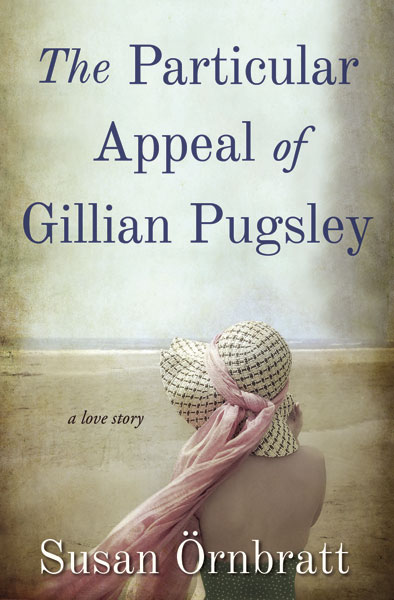
I am thrilled to reveal my novel’s cover to the public.  With a publisher and editor who had a remarkably similar vision for the cover as I did, the process was a pleasure. Thank you, Elizabeth, for bringing it to life and for making even me wonder, “what is out there, that Gillian is longing for?”

Copyright © 2014 Susan Örnbratt